Community and Coalition-Building
Coalition as continuous calibration: how DIY tech scenes design starting conditions that keep the room open – and what happens when those designs travel.
This text is stitched together from interviews, event traces, listings, follow-up questions, and (selective) first-hand observation – a reconstruction of how formats leave partial footprints.
Relation contaminates, sweetens, as a principle, or as flower dust.Édouard Glissant
Strange Adjacencies
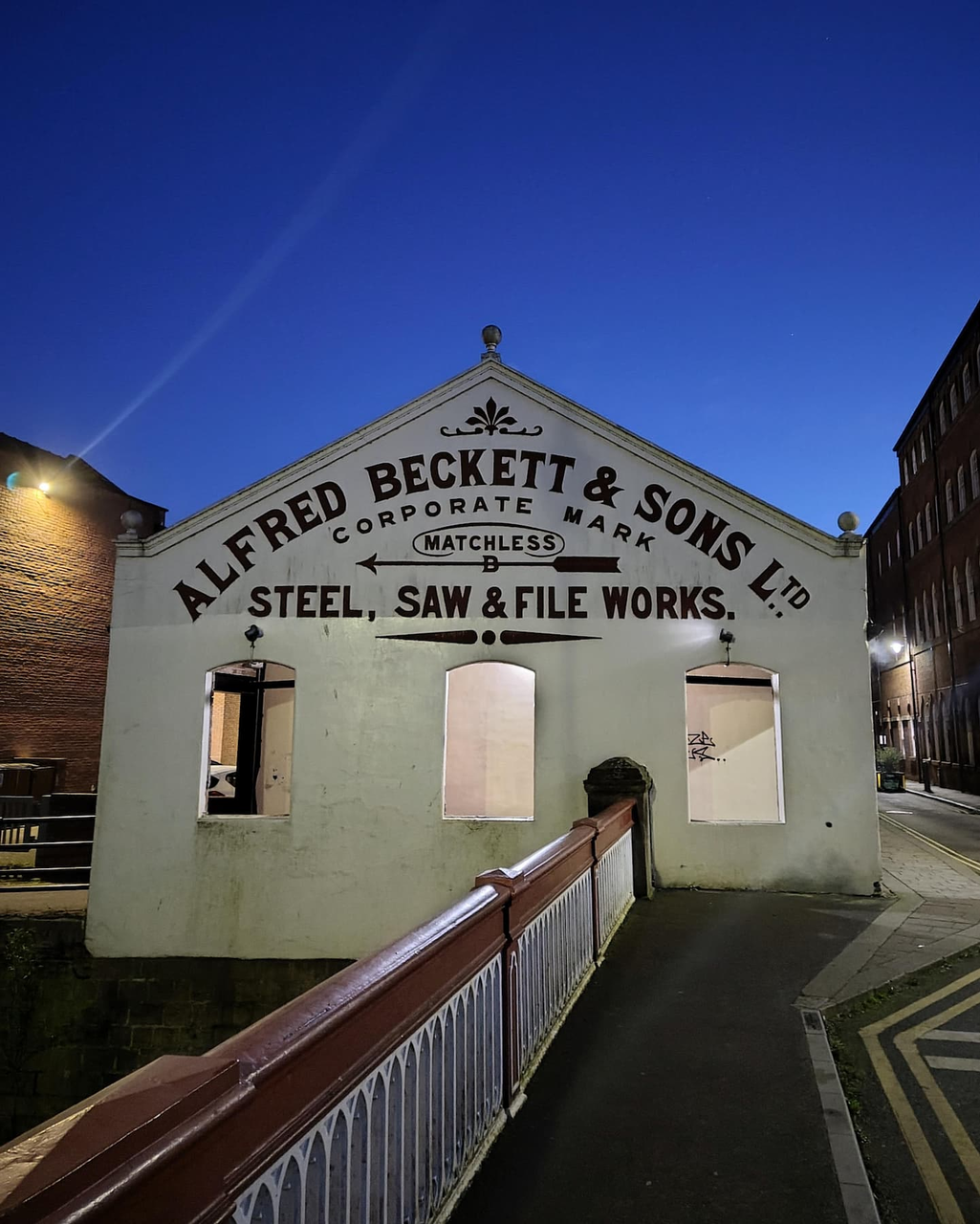
Sheffield's cutlery-makers – the Little Mesters – once hewed close to the waterwheels. Five rivers carved steep valleys through Pennine slopes, forcing workshops to scatter along power sites – geography constraining what arrangements were viable. By the mid-1840s, steam enabled denser configurations: no factory, but hundreds of urban workshops. A grinder works a blade at a wheel powered by transmission from two streets away; he feels the steam engine before he hears it – tremors through bench legs, dust motes dancing, vibration carrying coordination across distance.
The blade arrived from a forger's workshop courtyards over. Once ground, it moves to a cutler for handle-fitting. Neither forger nor cutler knows the grinder's name. Yet the blades circulate, coordinated through factors – merchant intermediaries who never touch the knives. “Like a huge factory which scatters its separate departments in different parts of the town, … like so many links in a chain” The Penny Magazine (1844) , say contemporaries, struggling to recognise industrial organisation without concentration.
What they see but can’t name is a particular configuration: density (hundreds of workshops, goods circulating maker-to-maker), autonomy (distributed ownership, specialised mastery), precarity (minimal capital, economic fragility). Too fragmented for factory consolidation, too specialised for individual self-sufficiency. The distributed structure persists through its affordances – this configuration has capacities other arrangements don't.
What does 19th-century cutlery have to do with 21st-century live coding?
The question itself does coalitional work – staging an encounter across time and practice to make structural patterns visible. So let’s ask differently: What stays constant when everything else transforms? What relations persist when material, actors, and technologies change?
Distributed coordination without centralised control. Specialists maintaining independence while facilitating circulation. Sheffield's Little Mesters developed this configuration not by design but under constraint. The cutlery trade went, but configurations leave residue – spatial patterns, cheap workshops, habits of distributed coordination that settle into a city’s fabric. Sheffield's DIY tech scenes didn't inherit a blueprint. They found a city grooved for distributed making, and worked the grooves.
Sheffield as method
Sheffield is a place where coherence is an achievement, repeatedly assembled. If you know Pittsburgh, the Ruhr, or any city where heavy industry has left pride alongside scar tissue, think in that register, but with steep hills and green edges braided through the city – rivers and valleys pulling settlements into proximity while resisting a single centre.
That topology, coupled with industrial pressure, produced a long history of organisation without neat concentration: workshops scattered across slopes and courtyards, bound into something like a collective machine by intermediaries, shared infrastructures, reputations, standards, and the everyday work of getting things from one place to another.
Looking from Sheffield makes ‘community’ legible as an achievement of circulation, as much as a pre-given identity: who and what moves, who brokers, who gets excluded, what remains stubbornly local, what can scale without flattening differences. Technology appears less as heroic invention than connective tissue – steam rented by the room; rooms and venues rented by the night – making collaboration possible by redistributing risk. Sheffield as method insists that solidarity is not the opposite of fragmentation: it is what coalition tries to build with fragmentation, through adjacency, interface, and shared constraints.
Access Space offered one such interface. Access Space was founded in 2000 as a free media lab. The description here draws on its form in the late 2010s, working from interviews and published accounts. Alex McLean – live coder, scene organiser, and Access Space trustee – describes the venue as ‘a sort of Media Lab … free software, open source oriented’: an anarchic room where you could try things, while meeting the people who’d go on to become your collaborators. At first sight, it looked – as one local magazine put it – "like an internet cafe jumbled into an art gallery": a drop-in space running on donated machines, volunteer time, and a willingness to learn in public. Refurbished PCs and Linux made it cheap to begin; an abundance of spare parts made it safe to make mistakes: break, fix, and try again.
A room sustaining specialisation that isolation couldn’t, helping people rehearse projects (and selves) not yet affordable or fully formed. Coordination happened through a mailing list and the simple fact of co-presence; performance and teaching as two faces of the same repeated encounter, materialised in shared tools and repos. And when the address changed, the graph learned a new route.
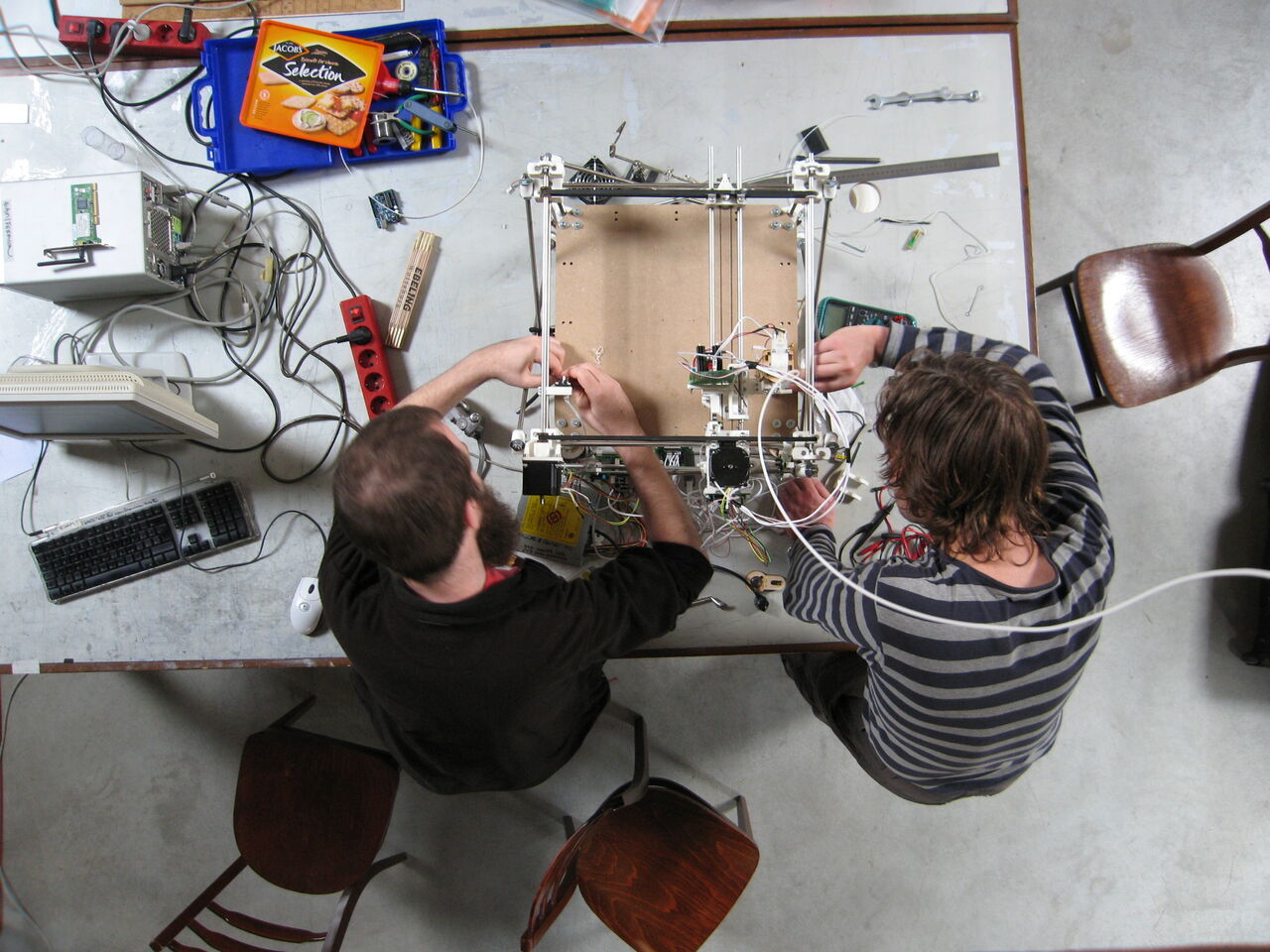 Building a self-replicating 3D printer, Fabbing Open Lab at FoAM in Brussels, 2007–2008
Pattern Club
Pattern refers to a whole family of techniques for working with regularities in the world … the way we perceive pattern is inextricably linked with the structured movements of its making.Alex McLean, ‘Algorithmic Pattern’ (2020)
20 Dec 2022, 18:00-20:00, Access Space @ Event Central, Fargate, opposite Marks & Spencer. Pattern Club’s third meetup: a textiles-focused, hands-on kumihimo workshop. Here the scene is legible in its traces – listings, formats, venue changes – and how each meetup shifts who participates and on what terms.
Pattern Club changes the substrate; starting with two live-coding sessions, then pivoting into kumihimo, a Japanese braiding technique using weighted threads around a disc. Recognition has to happen laterally, through proximity, without asserting code (or craft) as the common frame. A club in the literal sense: in that early run, this meant regular two-hour sessions on a Tuesday night, a borrowed room, and an invitation pitched at beginners. A code of conduct prominent on the website, doing its work before anyone arrived.
Subsequent meetups would focus on Andean khipu, kambi kolam. Andean khipu: knotted-cord systems for recording and communicating information; kambi kolam: South Indian threshold patterns, a single unbroken line drawn in rice flour at dawn. The series refuses the usual arc: expert explains, novices receive. Instead it gives people space to work out what “algorithmic pattern” can mean, by changing the materials/practice and letting the format teach.
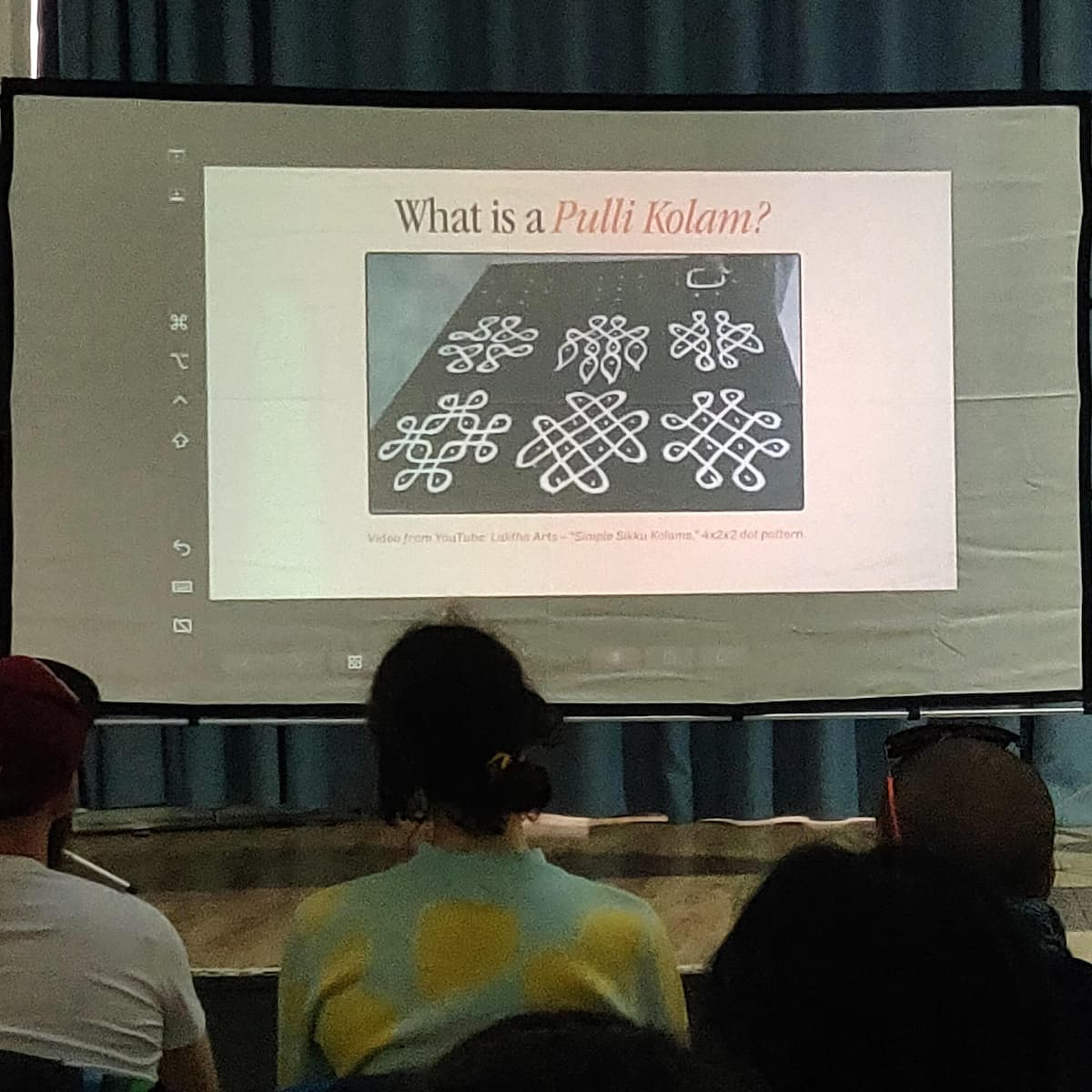
Because in these scenes, changing the substrate changes the crowd. Events about textiles tend to draw more women participants. Elsewhere around the same time, Alex recalls a separate event centred on the programming system Realtalk attracting “all men”. Pattern Club’s alternating materials/practices – an approach shaped by McLean and fellow organisers Ray Morrison and Lucy Cheesman – becomes an infrastructural interruption of this self-sorting: a way to prevent any single “technical” frame from becoming the default. Later, the organisers pulled a second lever – venue politics – moving Pattern Club sessions to Gut Level, a queer-led space, seeing this as an opportunity to bend the room differently.
The point isn’t an equity hack so much as a way of building humility into the format: each shift forces the terms of recognition to be renegotiated. When evaluation centres energy and exploration, who gets to feel competent shifts across sessions and substrates. This emphasis on energy over quality or technical excellence draws on Thomas Hirschhorn's 'Energy: Yes! Quality: No!' (2013), a manifesto that doubles as a workshop format, arguing that energy includes, while quality always makes a cut. This starts before anyone arrives: “technology” already calls some people in, while warning others off. Self-sorting loops, reputation cues – the ecology isn’t level. If everything worked, you wouldn’t need to engineer adjacency; you’d just show up and it would already be fine.
Coalition is what you do when the room is already bent.
The kumihimo workshop provided participants with foam discs and yarn in multiple colours – minimal materials, no specialised equipment, no prior experience. Modern foam braiding discs hold threads in notches around the edge and feed the growing braid through a hole at the centre, turning pattern into a sequence you can follow. Threads sit in specific positions, hands move them in rhythmic steps, the cord accumulating. Small parameter changes – colour order, crossing sequence – propagate into the emerging design, so participants encounter repetition and variation in a different register: in tension, counting, and the occasional glitch they have to unwork. A practice with its own vocabulary, which the club treats as equal to any other.
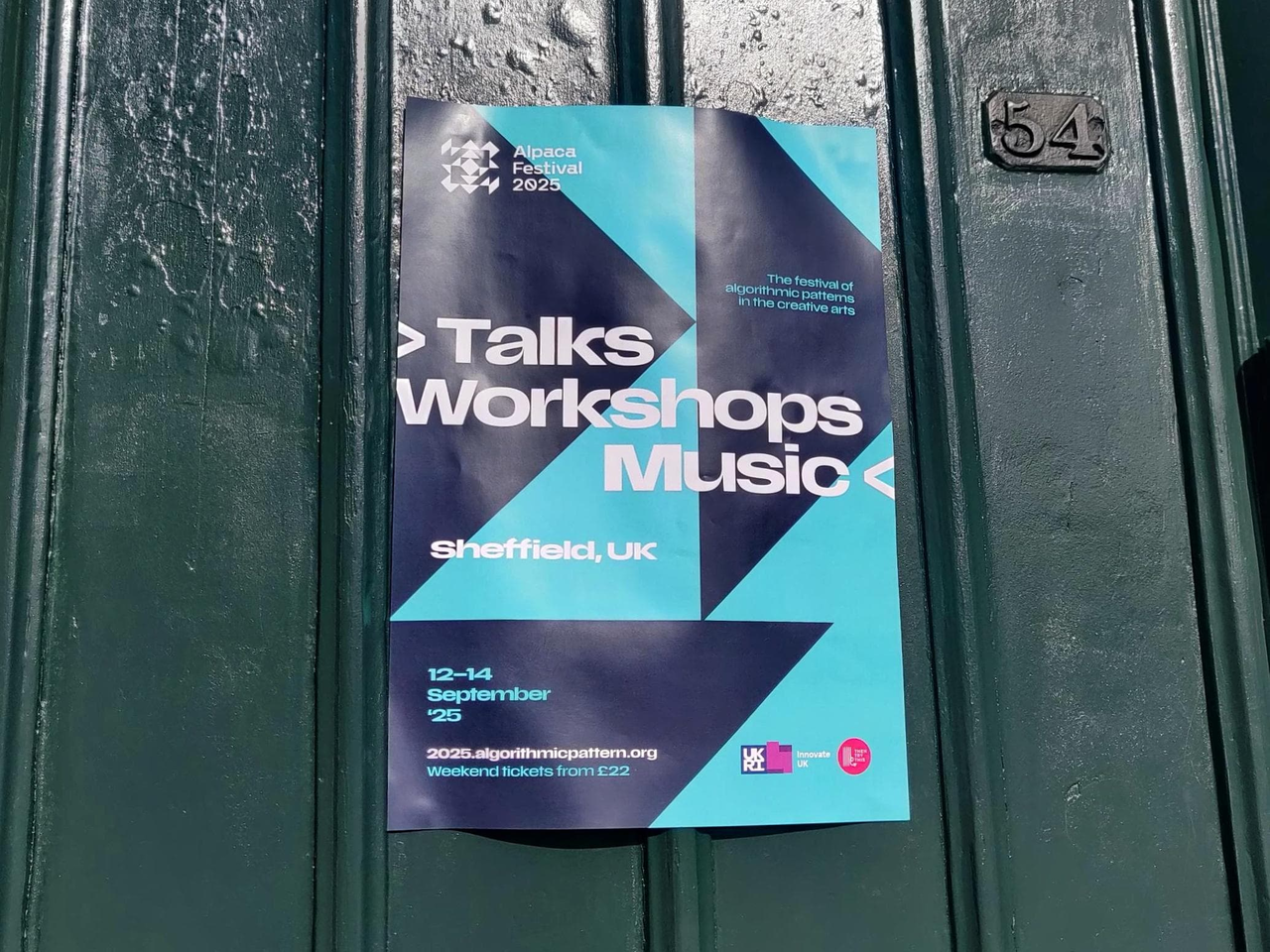
By 2024–25, infrastructural pressures and opportunities reshaped Pattern Club's format. UKRI funding enabled a Winter School pilot: four sessions introducing patterns across carnatic music, dance, modular origami, and video synthesis – different entry points, with browser-based livecoding environment Strudel as a shared through-line, giving the cohort something to build across. Free to participants but paying organisers and session leaders, this marked a shift from volunteer-run drop-ins to resourced programming; trading DIY autonomy for capacity and reach.
The template itself became explicitly replicable: “Anyone can run a Pattern Club,” noted McLean, “but with this, we're going to try and make course materials that people can copy.” Worksheets, session plans, documentation: infrastructure for template propagation. But turning something into a template introduces its own tensions. 24 applications, 12 places: the cohort format enabled continuity (exploration becoming collaboration; skills and relationships accumulating) while creating gates (selection, commitment, stability demanded). Not failure but negotiation: every parameter adjustment – free participation, paid facilitation, limited places, documented materials – calibrating scalability against intimacy, access against depth.
Pattern Club Winter School, Sheffield, early 2025. Four sessions explored patterns across live coding, flamenco dance, modular origami, and video synthesis. Film by Eva Yap. Music by Sarah Heneghan, Zebedee Budworth, and Alex McLean.
What remains invariant?A refusal of sovereignty: Pattern Club's core mechanism prevents any single material, practice, or discourse from becoming the one true frame. Rotating materials and practices is deliberate anti-capture engineering, redistributing expertise and changing who gets to feel competent from session to session.
What deforms? Everything material – substrates, spaces, rhythms, crowd, even the template itself. These aren't deviations from an ideal form but the mechanism working as designed: coalition as continuous calibration, adjusting parameters to keep ‘pattern’ as a working commonality across practices without pretending they’re the same.
Algorave
The first place algorave really worked wasn't where it started. The “rave” in “algorave” first fully materialised in Mexico City – not in club venues, but basements. While algoraves in Sheffield, London, New York often took place in clubs and performance spaces, Mexico City developed 'algoreven', substituting 'reven' – Chilango slang for party – for 'rave'. The linguistic move signalled a spatial shift: algoreven operated in basements turned party spaces – underground, minimal budget, unevenly archived. These weren’t just performance spaces hosting dance music, but party spaces that incorporated live code. When Alex McLean visited Mexico City for the vivo festival and found people “really dancing”, he was encountering algoreven's inversion: the party was already the substrate, not something the algorithm had to create.
But how did the template become portable enough to enable such an adaptation? UK rave culture was criminalised and re-routed by the 1994 Criminal Justice Act, which defined a ‘rave’, in part, as music ‘wholly or predominantly characterised by the emission of a succession of repetitive beats.’ Algorave emerged from that afterlife. The term 'algorave' was coined by Alex McLean and Nick Collins in 2011, growing out of an existing live coding scene. McLean describes the origin story – happy hardcore on a pirate radio station during a drive down the M1 – as part-myth, part-memory: “There's some truth in it … but we had for a while been trying to come up with a musical genre that would bring things together, as a community.” Years later, the definition resurfaced as ‘repetitive conditionals’, parodying the Act’s original formulation from a position of relative safety (licensed venues, institutional cover, manageable scale).
Repetitive beats. Between 1994–2011, the Act’s definition escaped its legal setting, circulating as a cultural object. Artists and organisers quoted it, joked with it, engineered music to dodge its wording (Autechre’s Anti EP, 1994). ‘Repetitive conditionals’ dropped into that pre-formed groove.
UK algorave operates in small licensed venues with capacities of one to three hundred people. This might look like accommodation, even like defeat – rave translated into a kind of academic computer music, stripped of its working-class material conditions and original political stakes. This domestication made the format portable while rendering it institutionally legible. Venues that couldn't host 'raves' could host 'algoraves.' The CJA forced compression: rave culture's spatial autonomy, mass scale, and illegality couldn't transmit through post-1994 frameworks. What remained (music, minimal infrastructure, ‘repetitive conditionals’) became the template.
Because UK algorave operated within legal frameworks, because it specified only minimal technical requirements, because it emerged from institutional contexts, the template could travel without requiring recipients to navigate the UK's regulatory environment, or take equivalent legal risks. Sheffield's constraints became Mexico's affordances.
Algorave works differently depending on where you put it. The compressed template travelled as a lightweight package. Mexican practitioners decompressed it using local party infrastructure, filling the gaps with what was available. The minimal spec (speakers, projector, code) worked differently in basements where parties already happened and dancing was the default. As Paulina Casas Lias recalls, at one event, a performer's Mac mirrored a phone notification mid-set – his wife calling – and the ringtone merged with the live code, becoming part of the music. Accidental proof of liveness: the system was open enough for the world to get in.
As McLean observed, Mexican practitioners “were trying to do what they thought we were doing in Europe, but … they really made it happen.” The productive misunderstanding: they built from algorave's aspirations (the name’s promise), not its constrained reality (licensed venues, academic contexts), recovering spatial practices – collective dancing in non-institutional spaces – the compression had stripped out.
The template resists capture through organisational absence: no central owner, no franchise (‘Algorave is not a protected brand or franchise, you are free to do what you like with it’). The published guidelines collapse hierarchy (‘headliners generally frowned upon’), urge institutional wariness (‘be wary of institutions’), and insist on affordability (‘pay-what-you-can-afford pricing’). The infrastructure matches the ethos: guidelines shared on GitHub in seven languages, a code of conduct in three, everything forkable. When Mexican practitioners created 'algoreven,' they substituted local slang and spatial framing without seeking permission – there was no one to ask, nothing protected to violate. The minimum specification (speakers, projector, code) enables endless local variation. The scene resists capture by remaining too distributed, too varied, too loosely specified for any single entity to claim.
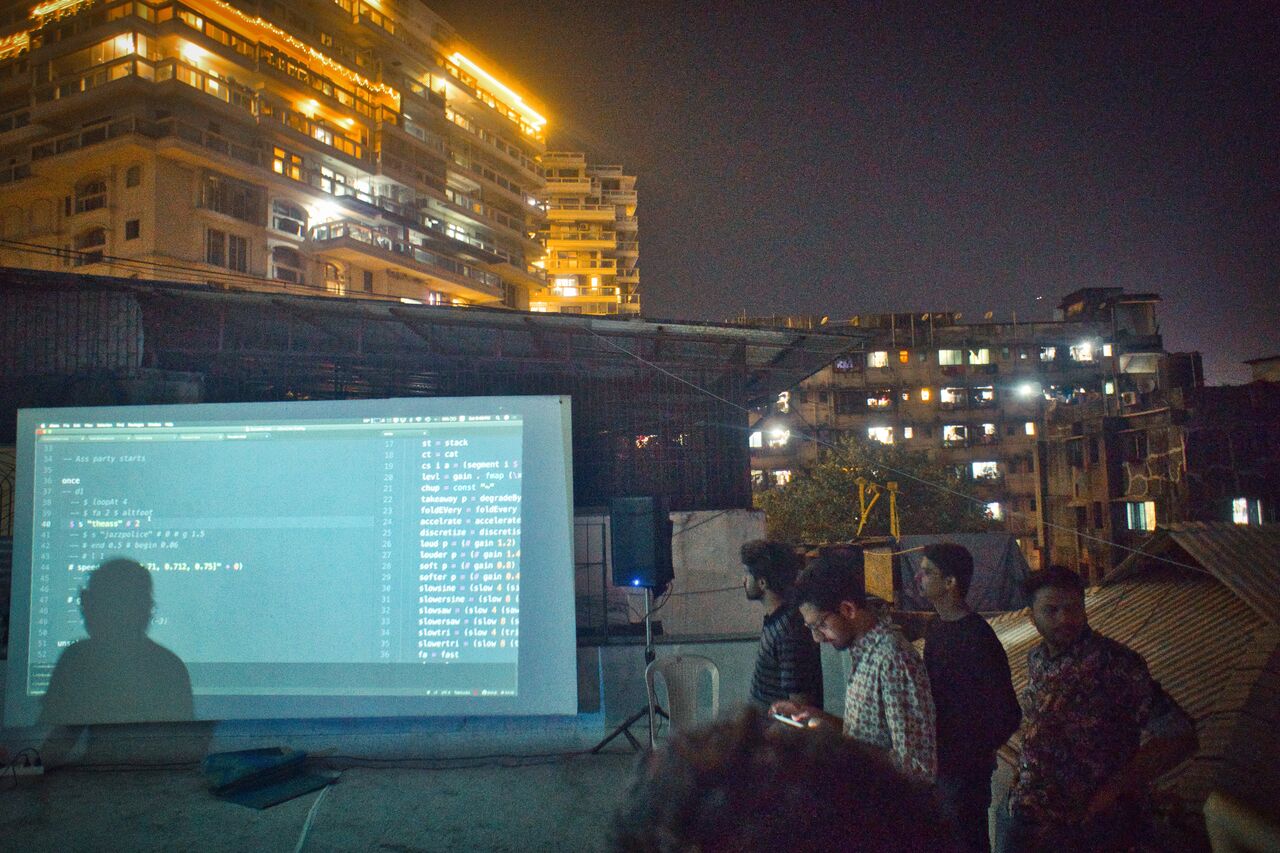 Live coding on a rooftop, Chuim Village, Bandra, Mumbai, December 2019. Photo: Dhanya Pilo / Abhinay Khoparzi. CC BY-SA 4.0
What remains invariant across algorave/algoreven formations? A thin contract: the music is being made now, in public, through code-based performance; the ethos is open and forkable (free tools, anti-commercial stance); the frame is dance, in that people can move.
What deforms? Genre (techno to gabber to ambient to cumbia-influenced), specific formats (nine-minute “Mexican Roulette” improv versus open-ended sets), social scaffolding (institutional versus DIY), venues (basements versus clubs), and spatial framing (party versus performance).
Dorkbot
Twice a year, more or less, Manchester runs this small ritual: a university room briefly becomes a temporary public for process – people who didn’t arrive as a public becoming one through shared witnessing. You arrive after work. The doors open early, but not too early – enough for the awkward pre-talk hovering, late enough that it still feels like an after-hours intrusion into institutional space. In the plate-glass modernity of SODA Manchester Metropolitan University’s School of Digital Arts , the room is lit like a demo: projector glow, a long table of ambiguous objects, cables snaking, laptops waking up. The first ten minutes are calibration. Objects as tuning forks. People orbit the demos; quick scan for familiar faces, slow scan for who might become familiar later.
Pizza sometimes appears – less hospitality than infrastructure. You can come even if you’re skint; you can justify the train fare because the evening isn’t only talks. And because it isn’t weekly, it stays something worth travelling for, so people from Bolton or Rochdale can make the journey pay off. There’s always the second half, semi-permeable, pub-bound – the conversations that wouldn’t quite fit into the room.
The protocol asserts itself: three talks in twenty-minute chunks, and a few five-minute ‘Open Dork’ slots. The time limit forces presenters to decide what matters, and gives the audience permission not to understand everything. What the format wants is a process talk, not a portfolio talk – excitement, discovery.
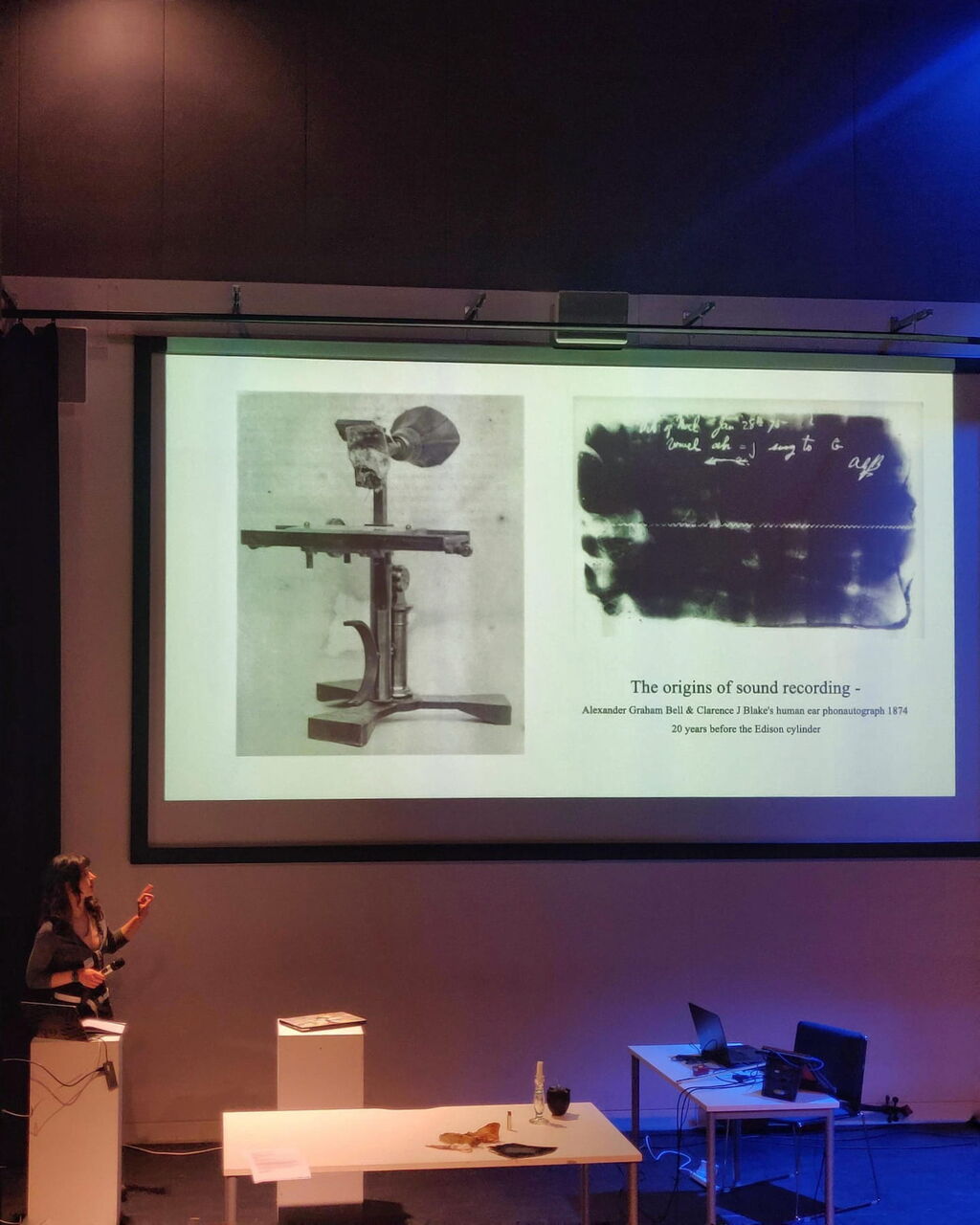 Glass artist Emma Mitchison discusses Bell and Blake's human ear phonautograph (1874) at Dorkbot Manchester #7, May 2025. The device, which used a real human ear to trace sound waves onto smoked glass, predated Edison's cylinder by twenty years.
The things shown are rarely purely digital or purely analogue. A pen plotter goes en plein air like an uncrewed landscape painter, Himalayan balsam as its subject. A village drowned in the 1980s resurfaces in drought, returning as found objects and an eight-channel soundscape. Oil paint meets cellular automata. Industrial fabrication becomes documentary performance: a “welcomed outsider” misusing factory machines while celebrating the skills and rhythms of those who work there.
What holds these together isn’t a theme so much as a willingness to show the seams. People show constraints, failures, awkward workarounds – just enough scaffolding that the struggle can be witnessed.
Sometimes the format creaks. A talk brushes up against marketing, or drops the phrase “Arts Council”, or admits to having sold some work. The room’s attention cools. Notebooks close; hands reach for phones. A small, collective check-out until the talk returns to process. Nobody heckles. The next thing is always coming; the protocol can absorb the lapse. When the technology itself fails – cables, screen-sharing, the inevitable gremlins – the organiser vamps, turning dead time into social infrastructure: turn to a stranger, talk to them about something, keeping the room in the room until the next thing starts.
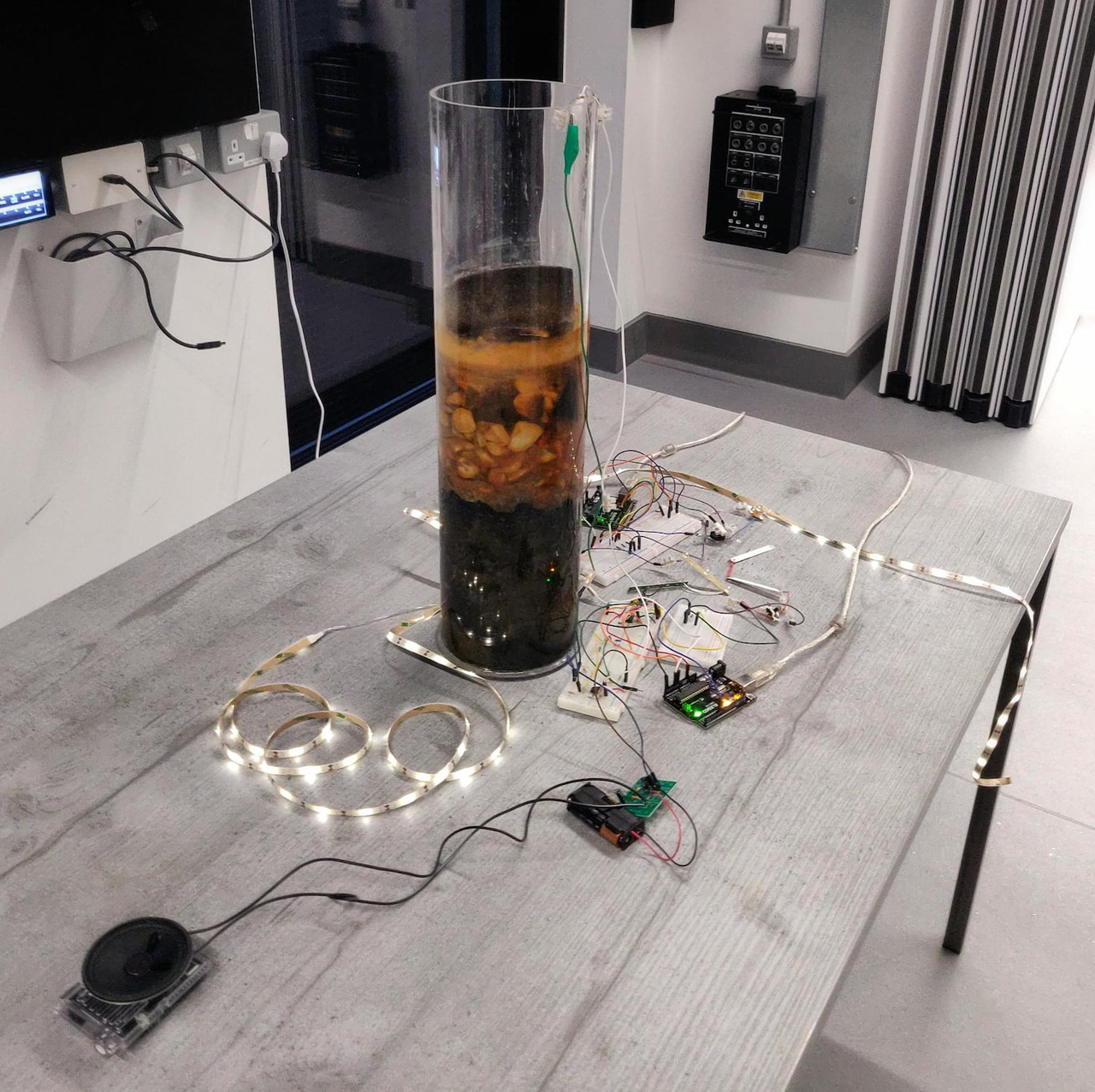
Like Pattern Club and algorave, Dorkbot travels – less a kit of parts than, from the inside, a feel for the room. In Manchester, it materialised as a name, a tagline (“people doing strange things with electricity”), and a time-boxed way of showing work. Manchester’s version lapsed, then restarted at #4, treating the 15-year gap as a temporary interruption. Dorkbot Manchester was re-established in 2023 by Henry Cooke, previously a co-organiser of Dorkbot London. The London chapter ran from 2001 at Limehouse Town Hall – a community space in London’s East End – with free entry and no registration. The Manchester fork makes more of the parts of the format that aren't talks.
The minimum spec is thin but forceful: free entry; 3×20 (three 20-minute talks); Open Dork; demos. The format is short enough to stop the room being captured by a single voice, long enough for process to become visible, and casual enough that mixed disciplines can share a single attention space.
For most, this could pass for an ordinary tech meetup: slides, microphones, a room in rows. But its social technology is closer to the older tradition of public demonstrations – electricity lectures, experimental showings. The problem isn’t persuasion but alignment. Dorkbot’s time boxes, its permission to show unfinished work, its tolerance for failure, are ways to get a room of strangers to witness the same event and agree, however provisionally, on what just happened. “Look what happens when I do this.”
What remains invariant? Time‑boxed witnessing – three 20‑minute presentations – and mixed‑audience legitimacy. Permission to show unfinished work, with failure treated as a shareable object (breakdowns, constraints, workarounds).
What deforms? Hosts and their terms, regional flavour (London as lecture series, Bristol attached to a hackspace, Manchester's initial run as a few people in a pub), organiser priorities, how norms get enforced.
Pollen Grains
Pollen grains. The things that travel between scenes are rarely the big idea. They’re small protocols, materials, jokes – partially understood, sometimes a little irritating – the sticky fragments that let other practices take root.
Alex McLean offered me ‘coalition’ as one such pollen grain – something he’d picked up from Emma Dabiri – in the final minutes of a multi-hour interview about practice, venues, Sheffield, the strange stuckness of certain tech spaces. For him, it wasn’t allyship, invitation, or an exhortation to be better people. It was a design problem: “setting up the starting conditions” so the room doesn’t drift toward dominance and dropout.
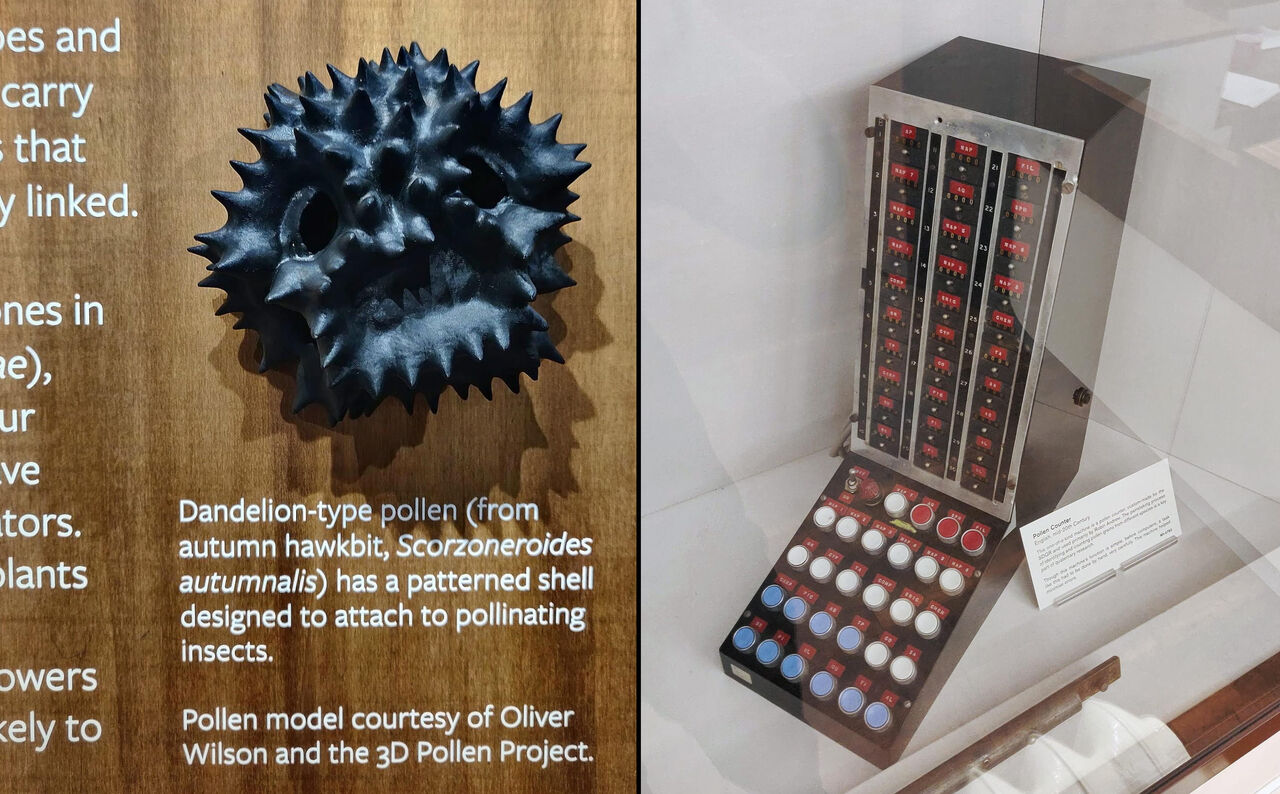
Glissant sits at the edge of these scenes like dust in a projector beam: relation contaminates, sweetens. Pollen, allergy, opacity. A refusal of clean borders. You don’t have to grasp the other to build with them; partial contact can be enough. Édouard Glissant (1928–2011): Martinican philosopher, poet, and novelist whose work emerged from Caribbean histories of creolisation – the unpredictable cultural forms born from the violence of plantation societies. His Poetics of Relationargued for a ‘right to opacity’: the right not to be fully grasped or reduced to categories legible to dominant frameworks. For Glissant, genuine relation doesn't require mutual transparency; what matters is the texture of the weave. But in too many tech spaces, opacity curdles and thickens into sphinx-riddles – “people talking in riddles to make themselves feel clever”, in Alex McLean’s words – performed as shibboleths, passwords, tests that turn the room into a threshold.
Opacity can be shelter, or it can be a weapon; the difference is who controls it and what it’s for.
Glissant's point is that you don't resolve this by demanding transparency – the demand is itself a form of capture, reducing the other to what your categories can hold. What these scenes attempt instead is witnessability: enough scaffolding to align perception around an event without demanding mastery. Legible enough to work with, maintained through a lot of often-invisible organiser labour.
Harney and Moten have a name for this kind of being-with around practice: study – ‘talking and walking around with other people, working, dancing, suffering, some irreducible convergence of all three.’ Unfinished, dissonant, often-improvised; not a curriculum. Instead, something closer to the conversations and witnessed failures that don't quite fit the timetable. Stefano Harney and Fred Moten, The Undercommons: Fugitive Planning & Black Study. Published freely under open access and circulated as samizdat among precarious academics.
Here, the pollen grains are the things that let practice travel without becoming a franchise: Pattern Club’s pattern, algorave’s code+ethos, Dorkbot’s strange things with electricity. They make it easier to arrive as a beginner, to deform a template, to show unfinished work without moral drama. They don’t solve stuckness; they loosen it. Coalition, in this telling, is less a goal than an emergent effect of well-tuned starting conditions.
These aren’t universal lessons but specific enactments, propagating beyond their originating contexts. Call it mutagenesis: productive misunderstanding that keeps the topology while changing the content.
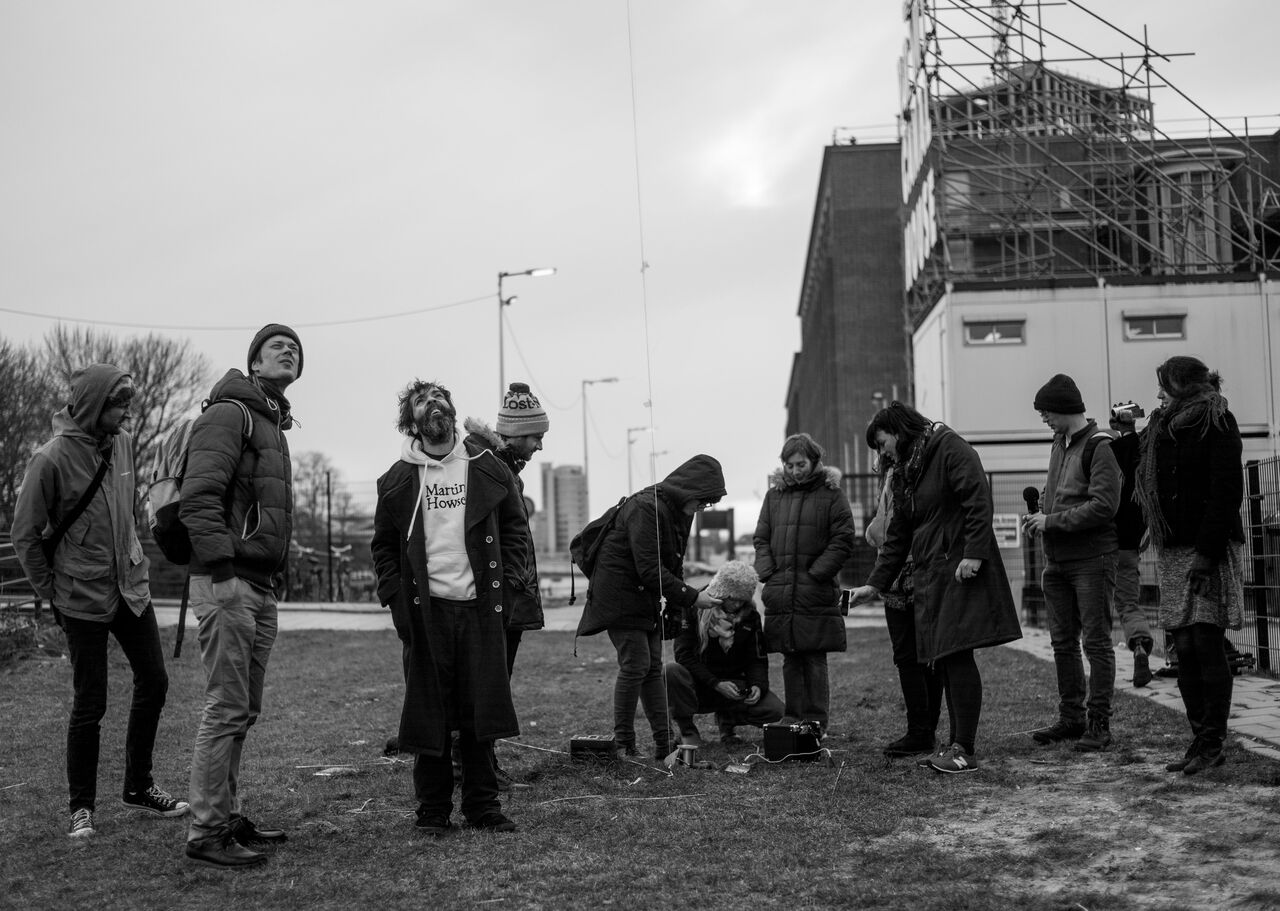 Earth Coding at the Sonic Acts Festival, 2015
🜛
Coalitional interfaces aren’t solutions, and they can’t be asked to do every organisational job. They cut against hierarchy, rapid scaling, extraction, assimilationist inclusion. What they can do is smaller and stranger: tune starting conditions so a room drifts toward witnessable process, make adjacency workable without demanding intimacy, let practices touch. And these formats leave traces in other formations, like FoAM's own Research Gatherings and Library Salons. Research Gatherings, which emerged from conversations with Dorkbot Ghent in the mid-2000s, ran a similar process for over a decade – a reminder that the pollen travels further than any single text can track.
What other recognition modes exist in your own terrains – beyond pattern, code+ethos, and witnessable vulnerability? What would it take to make them visible?
Everything here is offered from somewhere particular. Sheffield makes circulation and calibration easy to see – how formats become infrastructure, how infrastructure becomes politics. If any of these handles travel, they will be misunderstood. That’s fine. The transformation is the point.
This text owes a great deal to Alex McLean, whose interviews, reflections, and ongoing practice inform much of what's written here. Thanks to Henry Cooke for a generous conversation about Dorkbot Manchester and the work of organising; to Paulina Casas Lias for sharing stories and sources from the Mexico City livecoding scene; and to Jess Ghost for her thoughtful reflections on Pattern Club's Winter School. 💻
🜛