Dissecting a Möbius Strip
An exercise in mathematical reasoning – from conjecture, through evidence and observation, towards a proof.
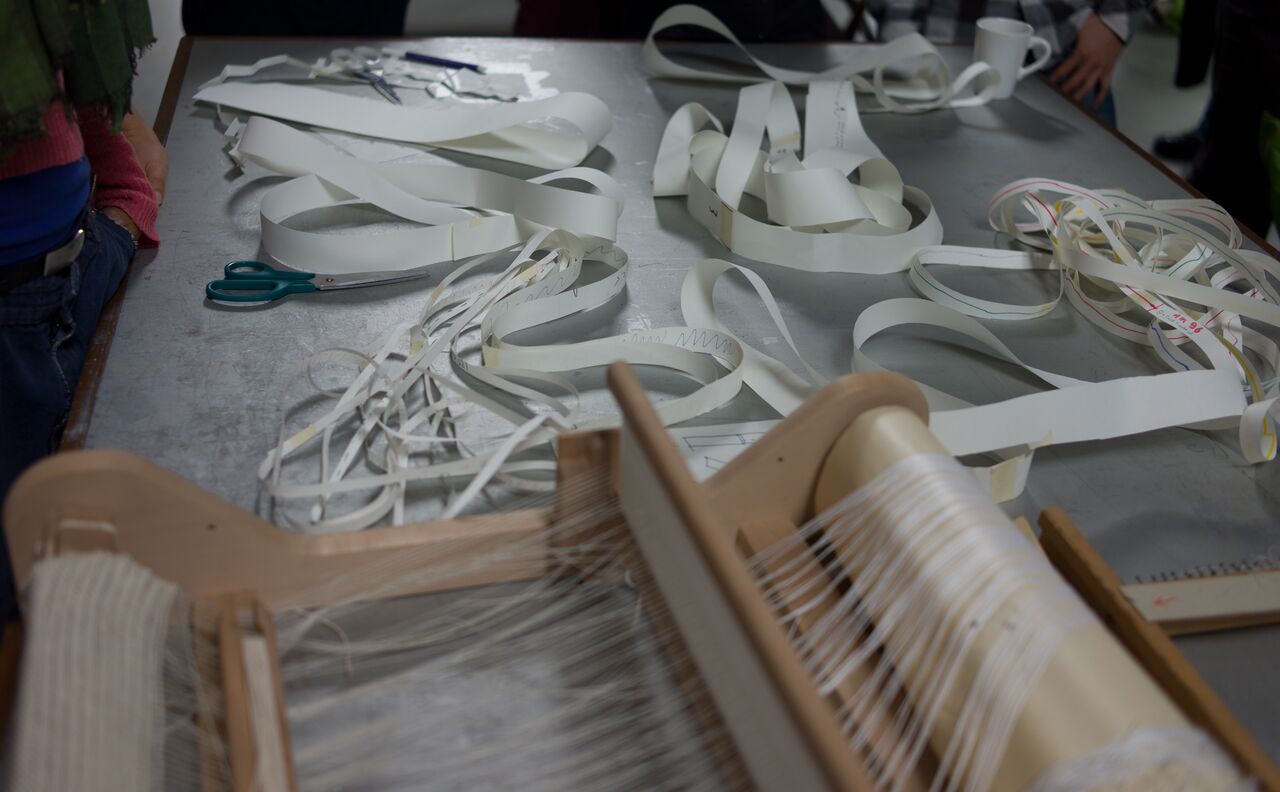
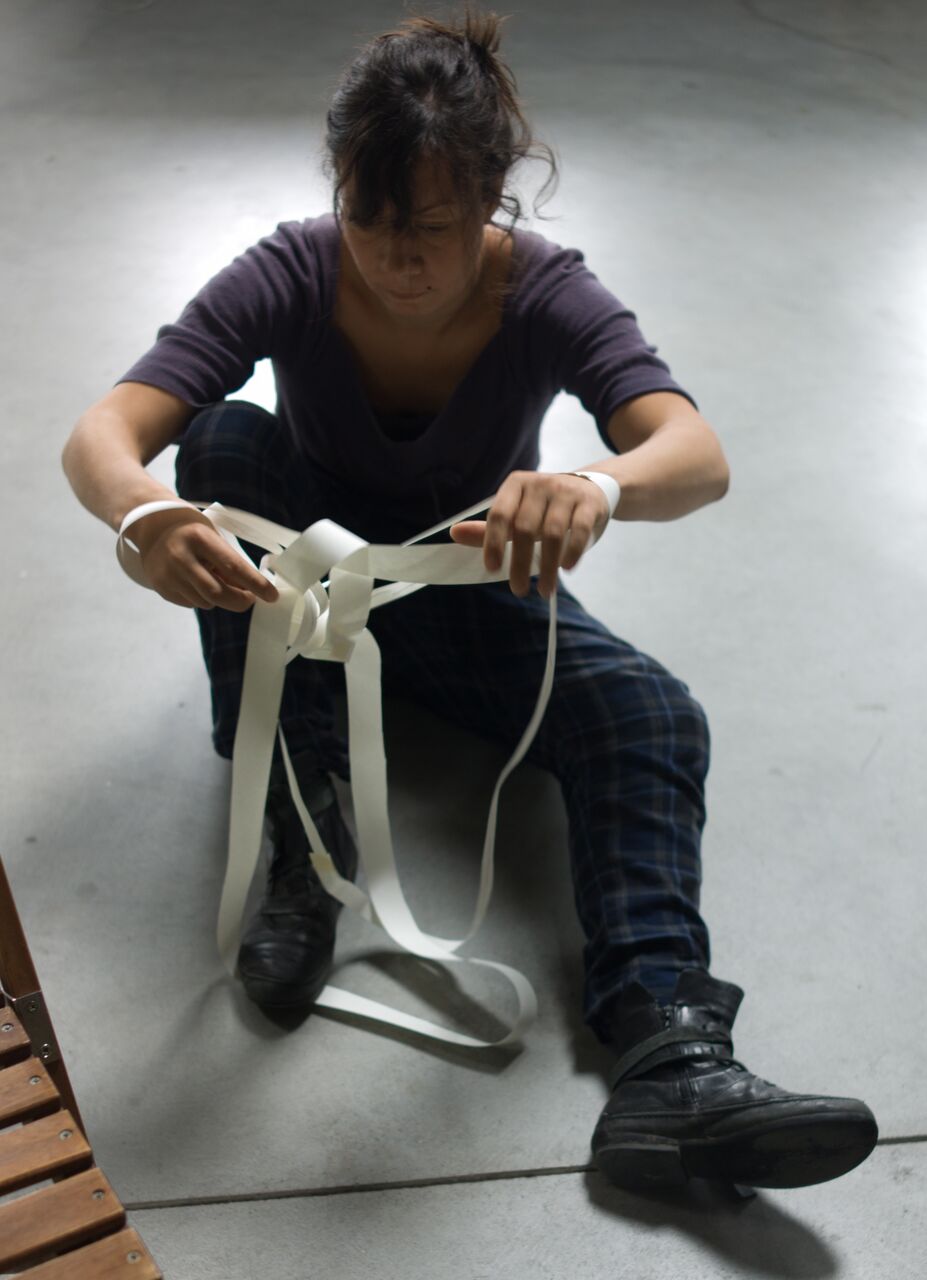
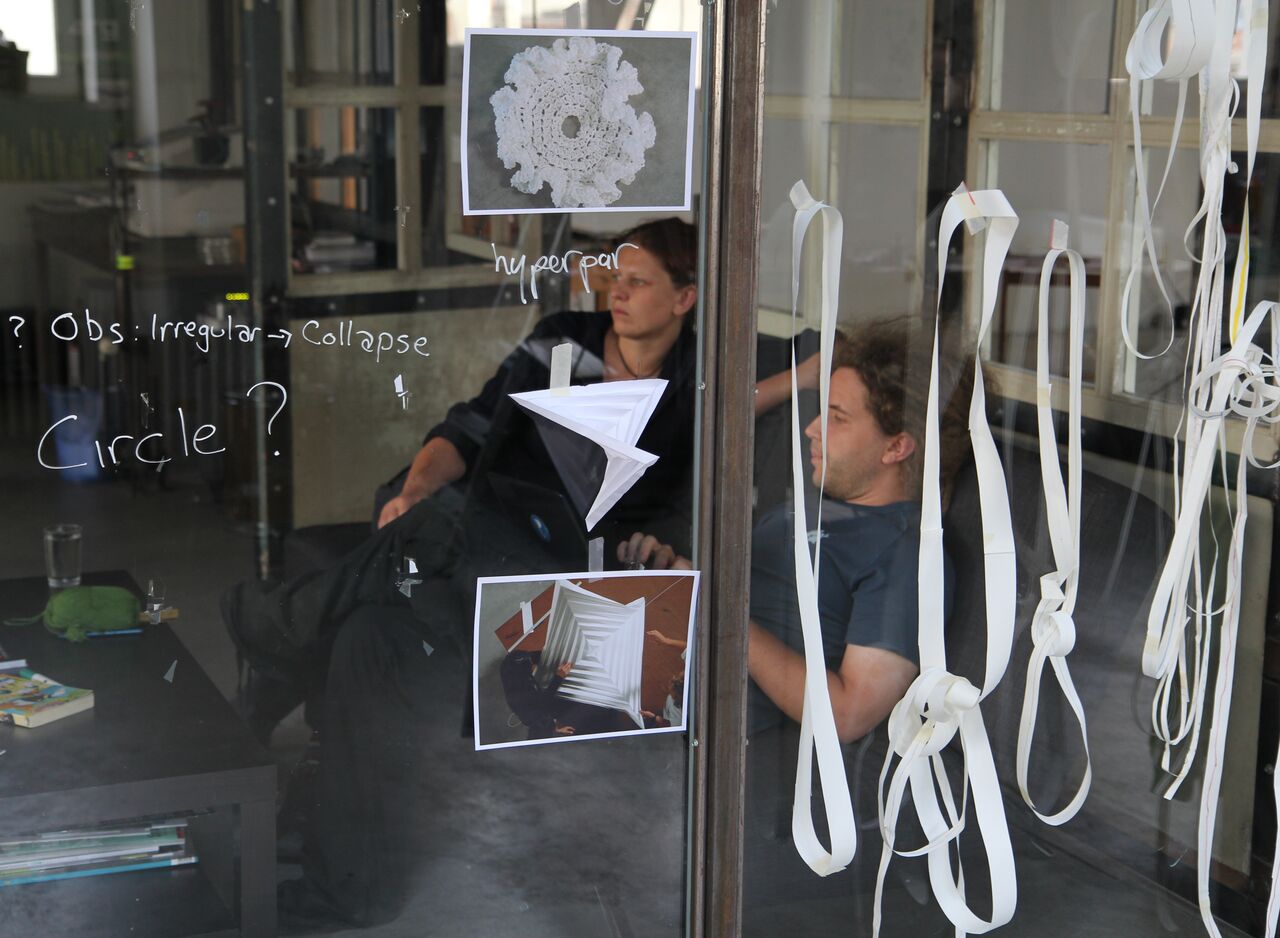
First conducted during the Mathematickal Arts workshop, which explored the intersections between maths, textiles and computer programming. The exercise began with cutting, counting and getting entangled in strips of paper. After creating mysteriously complex twists and tangles, the task was to translate the process into notation that could be used to replicate it. Words, diagrams and algorithms were deployed as sense-making tools, to better understand what happens to the Möbius strip when it is (repeatedly) cut.
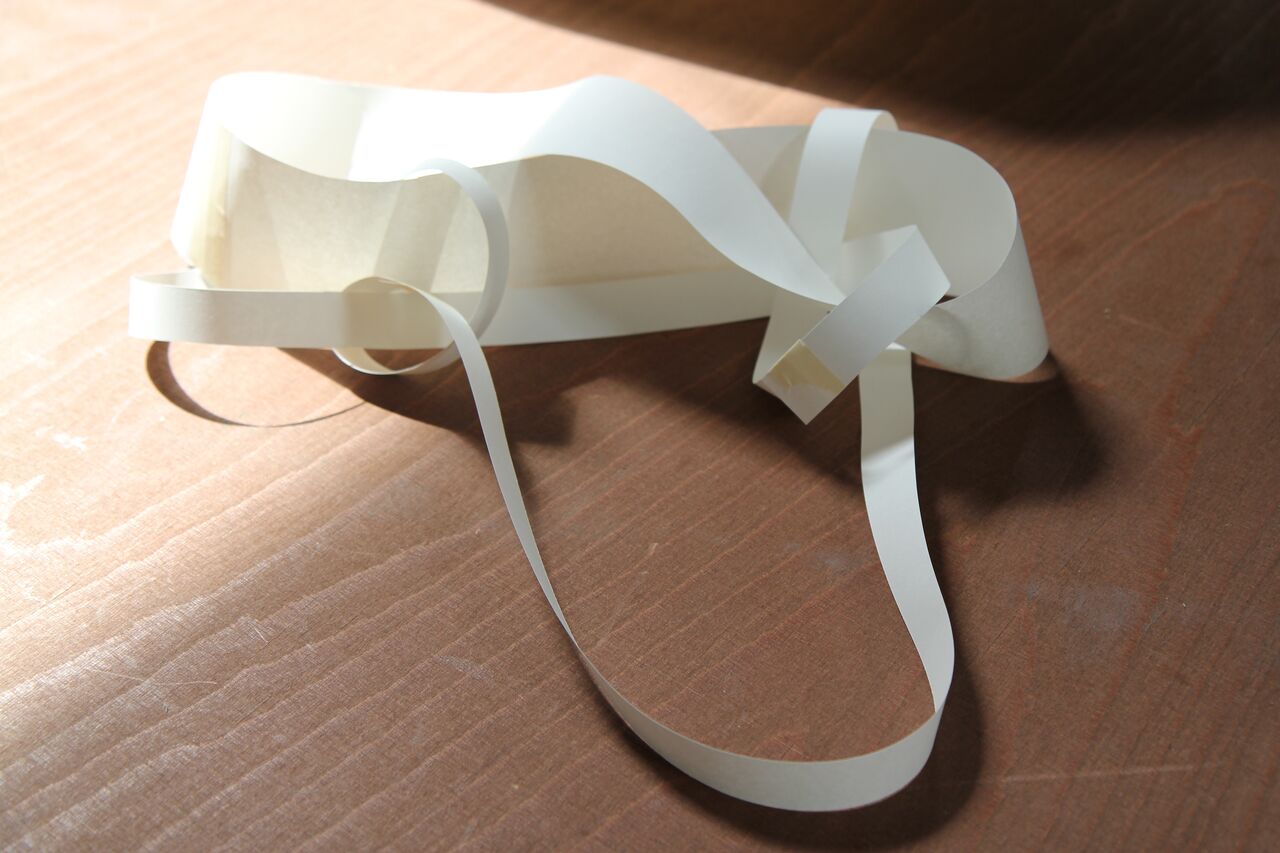
Imagine a Möbius strip and try to predict what will happen when you begin cutting it. How long will the strip be? How many twists and knots do you expect? How would you explain what happens to someone who would like to try it themselves? Start with hands-on experiments, then move to comparing and abstracting.
Cutting a Möbius strip along the center line yields one long strip with two full twists in it, rather than two separate strips; the result is not a Möbius strip. This happens because the original strip only has one edge which is twice as long as the original strip. Cutting creates a second independent edge, half of which was on each side of the scissors. Cutting this new, longer, strip down the middle creates two strips wound around each other, each with two full twists.
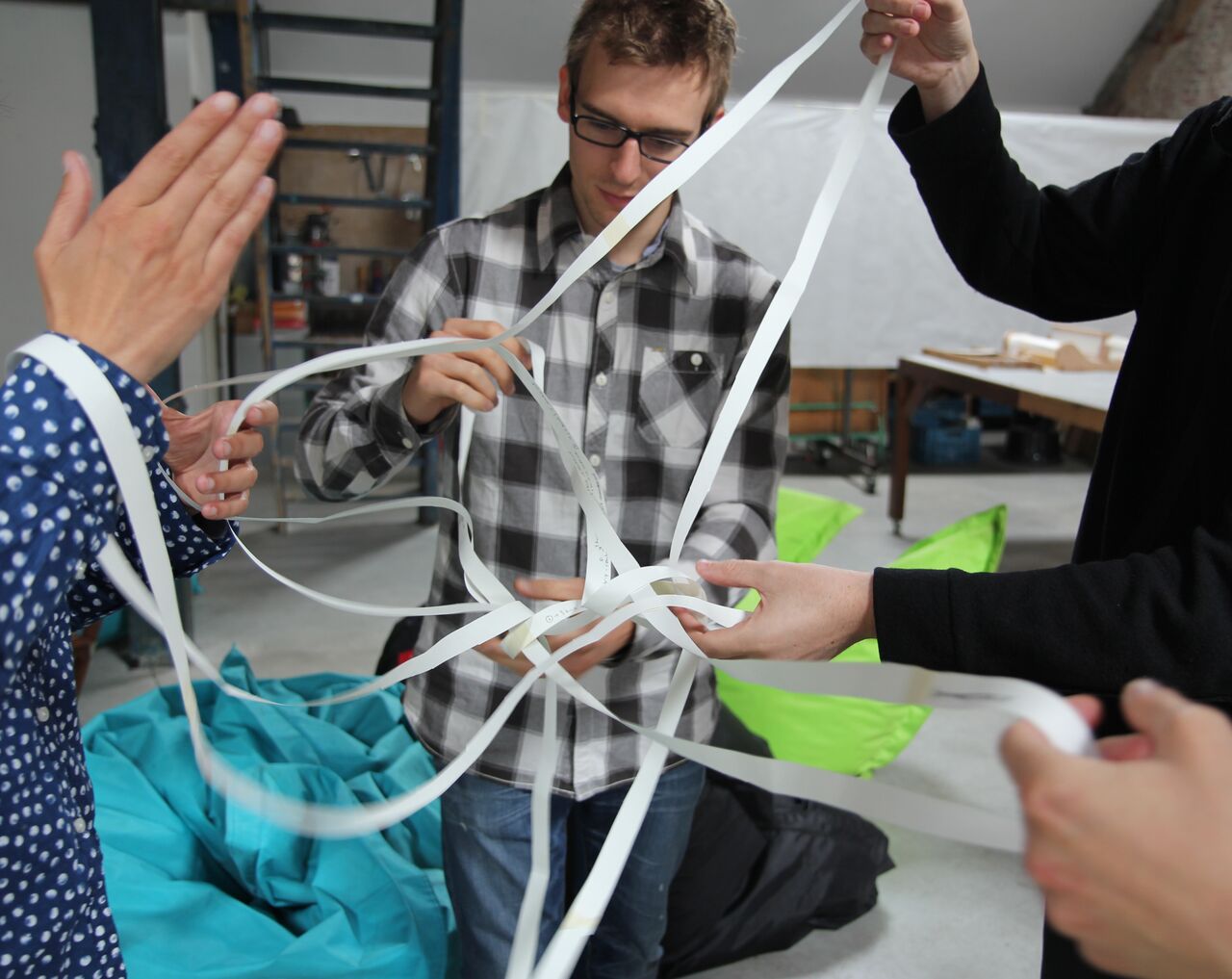
The process
Step 1: Make a Möbius strip by twisting and gluing a single strip of paper.
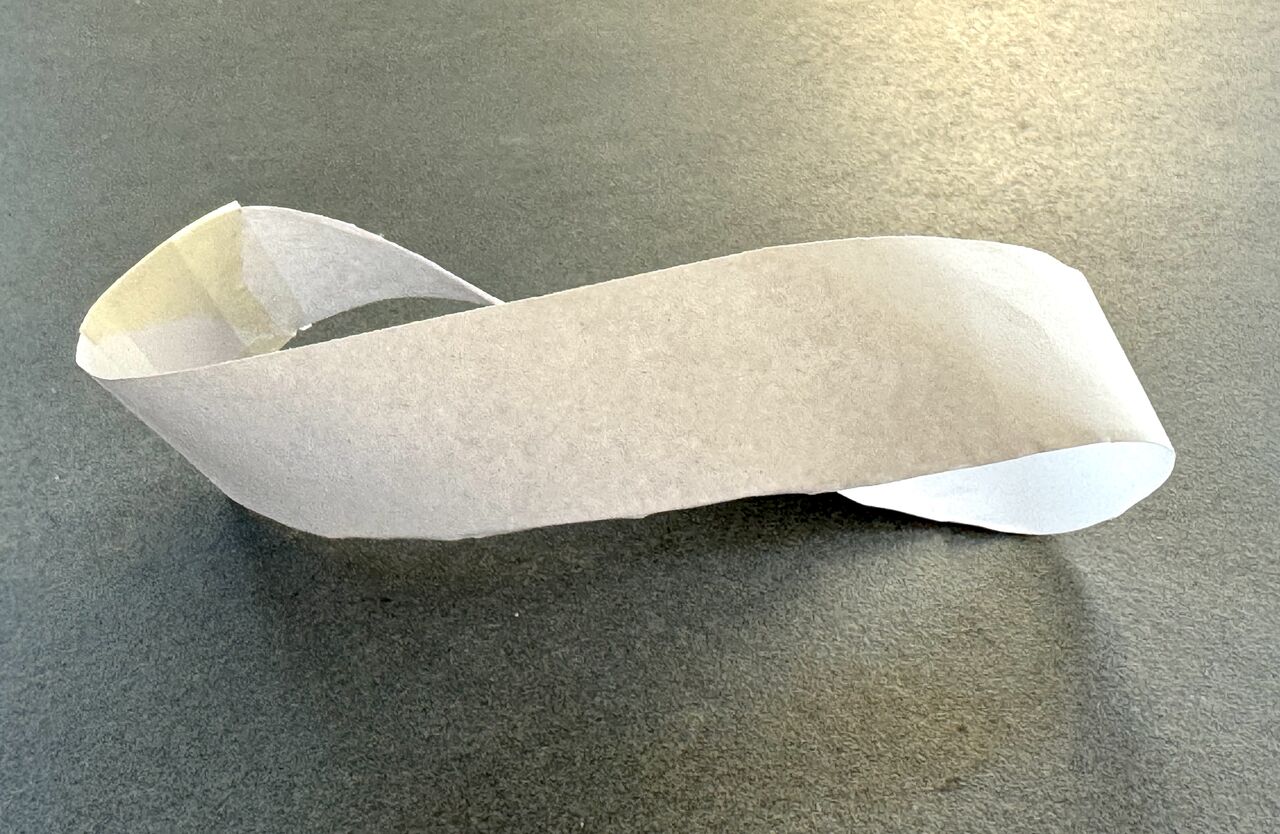
Step 2: Cut the Möbius strip into one or more strips. Note: There are many different conjectures possible from this simple starting point, and your intuition can be contrary to empirical evidence.
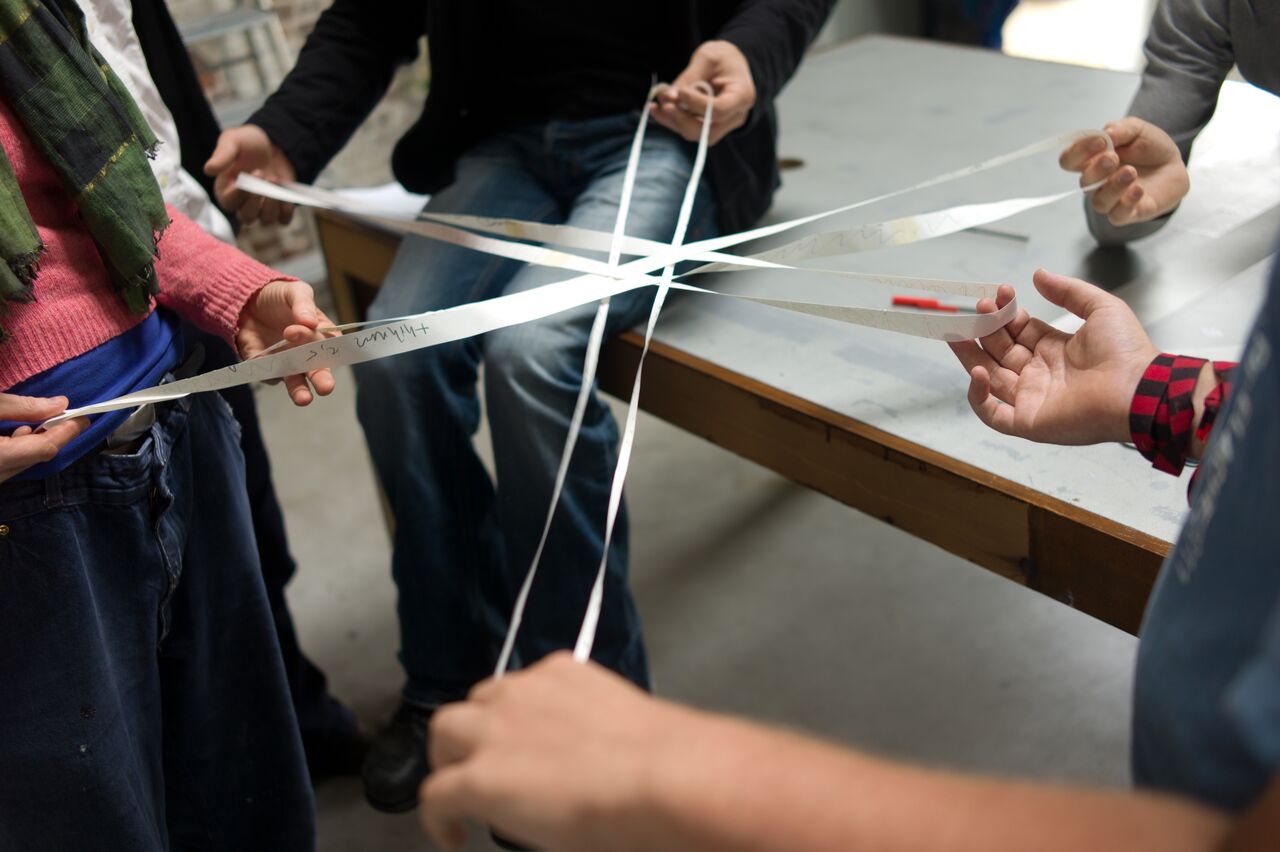
Step 3: Take notes. Summarise steps of the process, as a working notation.
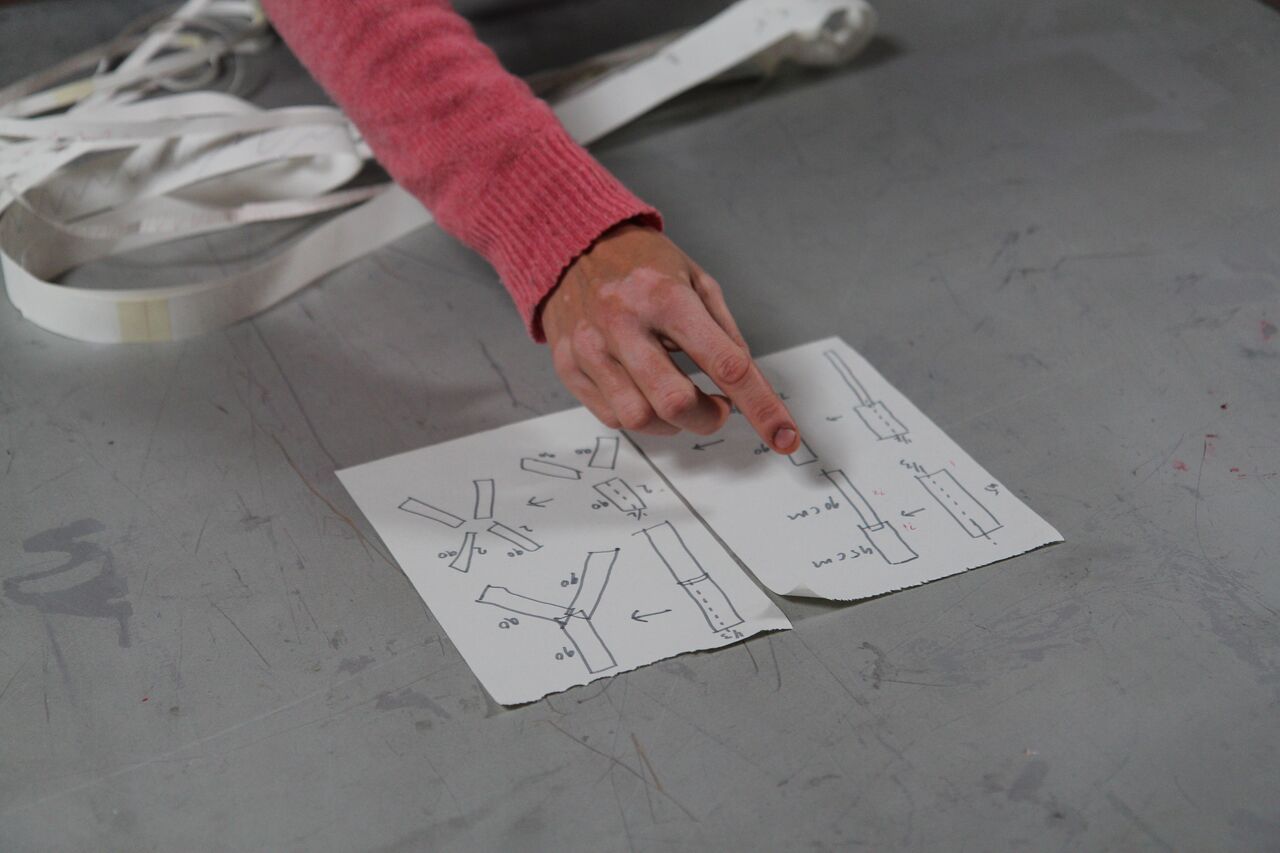
Step 4: Sketch a proof to be able to repeat the experiment.
This is precisely what common sense is for, to be jarred into uncommon sense. One of the chief services which mathematics has rendered the human race in the past century is to put "common sense" where it belongs, on the topmost shelf next to the dusty canister labelled "discarded nonsense."
Eric Temple Bell
A notational example
Conjecture: When the length is twice as long, it has twice as many twists; odd number of twists – you go around the loop twice, so you double the length and you double the twists – you can never get more than double the original length.
- odd number of twists → 1/2 cut → double length, double twist
- odd number of twists → 1/3 cut → double length, double twist + same length, same twist
Evidence:
- 1 twist 1/2 cut → two pieces of twice the length, 2 twists
- 1 twist, 1/3 cut → 1 same length, 1 twist + 1 2 lengths, 2 twists
Observations: Counting twists is hard. When you add patterns to your cuts, it gives you more headaches, but can become a creative exercise.
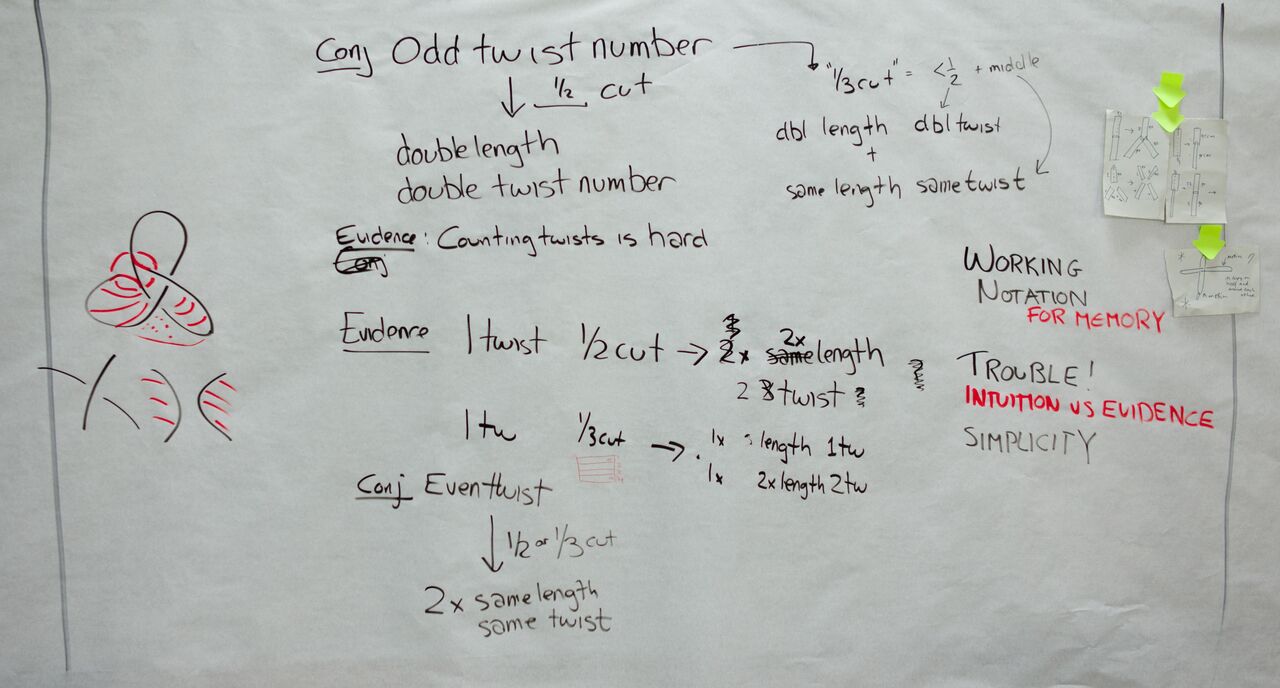
Proof: Formulating observations, moving from physical twistiness to diagrammatic attempts at clarity, creating descriptive terms, and then trying to make conjectures are all part of the mathematickal arts. Proof can come later.
To me the simple act of tying a knot is an adventure in unlimited space. A bit of string affords the dimensional latitude that is unique among the entities. For an uncomplicated strand is a palpable object that, for all practical purposes, possesses one dimension only. If we move a single strand in a plane, interlacing it at will, actual objects of beauty and of utility can result in what is practically two dimensions; and if we choose to direct our strand out of this one plane, another dimension is added which provides opportunity for an excursion that is limited only by the scope of our own imagery and the length of a ropemaker’s coil.The Ashley Book of Knots, Clifford W Ashley
Crafting at the Edge of Knowing
🜛